BY JEREMY BOCK
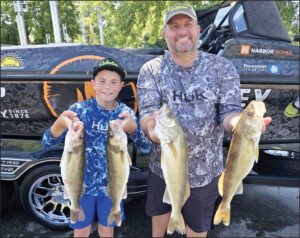
This past summer, I had the privilege of taking a father and son out on the water for a fishing trip. They had purchased the outing from a donation I had made, and their goal was to catch walleye by casting— but they were open to trolling if needed.
I knew casting would be a challenge that day as there was little to no wind, and after two hours and only one fish, they turned to me and said, “I guess we can give trolling a try.” It wasn’t exactly a ringing endorsement, but it gave me an opening to show them just how effective trolling, especially with Off Shore Tackle planer boards can be.
We headed to the mud flats, and using my electronics, I began scanning for pods of fish before setting up our trolling pass. Forward Facing Sonar has been a hot topic in the fishing world lately, especially for casting directly to fish, but it’s also something I use 100% of the time when trolling.
I run a Forward Facing Sonar mounted to my trolling motor, with the graph attached to a telescoping mount. This setup allows me to raise the graph high enough to see it from the back of the boat. It shows me the depth and location of fish in front of the boat, giving me the ability to adjust my lines accordingly. As the boat moves over the fish, they typically scatter to the sides but often stay at a similar depth which is key when setting your gear.
We started with crawler harnesses and I took some time to explain my Off Shore OR12 Side Planer Board setup. I run the OR18 Snapper Adjustable Tension Release on the bracket paired with the OR16 Pro Clip on the tail of the board. All of my boards are upgraded to the Tattle Flag® system, and I make full use of the spring tension options it offers.
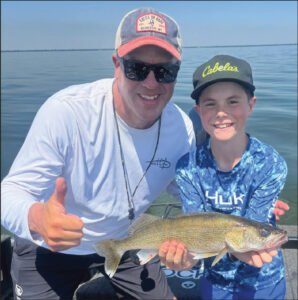
Lake Winnebago walleye caught while learning how to troll using Off Shore
Tackle products.
A lot of anglers overlook the Tattle Flag’s® adjustment holes, but those small tweaks can make a big difference. I usually run my flags with the lightest tension possible, especially when trolling with crawlers because fish will often come up and just “bump” the bait. That subtle flag movement is often the only indicator of a light bite, and the light setting lets me see it.
When we began trolling the graph lit up with fish, from the surface to the bottom, but we weren’t getting bit. Time for a change. I swapped out a few crawler harnesses for slow death rigs, which I’ve found to be incredibly effective when the bite gets finicky. I tie my own rigs, using a variety of blades and color combinations. Some are just a slow death hook and one bead; others have multiple beads with more complex color patterns.
Within 2 minutes of deploying the first slow death setup, a board went back. We landed a solid 20 inch walleye. Five minutes later, another fish, this time 21 inches. That was all the confirmation we needed. We switched four more lines to slow death rigs and over the next 90 minutes, we put 16 walleye in the boat with most being over 20 inches. For that body of water, it was an incredible day.
Beyond the fish, the boat was filled with big smiles, high-fives, and excitement. The father and son quickly learned how to set boards and run lines themselves. They were soon handling most of the spread, saying:
“Wow, we see how effective trolling can be and why it’s so important to be a versatile angler. Thank you for teaching us and letting us be hands-on.”
Though they didn’t yet own a boat, they were planning to purchase one in the fall and asked me to help them pick up a set of Off Shore Tackle planer boards and the necessary accessories, which I was more than happy to do. More importantly, their view on trolling completely changed, and they walked away better anglers.
SHARE YOUR KNOWLEDGE, CHANGE PERSPECTIVES
You can have the same kind of impact on others around you who love to fish. I don’t know anyone who doesn’t want to become a better angler and we all have something to offer. Whether it’s explaining your gear setup, demonstrating techniques, or simply encouraging someone to try a new method, those small moments can lead to big changes.
Look for the opportunity. Take the time to teach. Most importantly encourage.