
BY CAPTAIN ERIC HIRZEL
I’ve had a few customers recently ask me what I thought was my biggest key to consistently putting fish in the boat. Location of fish is key because you can’t catch fish that aren’t there. Fishing every day, sonar, networking, and GPS have made that into a relatively simple process. But the key to consistently putting fish in the boat is paying attention to detail.
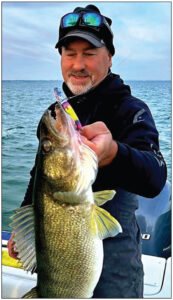
Whether you’re running a charter, fishing a tournament, or just “mom and pop” fun fishing, many components play into success or failure. Routinely or inadvertently taking short cuts, ignoring or taking things for granted all result in negative outcomes.
BOAT SETUP
Whether casting, jigging, vertically dropping live bait, or trolling, having the boat setup properly is critical. Running a charter business on Lake Erie means my boat must be rigged for all those techniques to accommodate my customers.
In a trolling situation there are many components that give us the best chance of success. Taking a few extra steps to tweak and refine those things puts you in a position to keep the bites coming. How closely you pay attention to detail will separate you from the average angler.
ELECTRONICS AND TROLLING
We know color and style of baits are important but relative speed and depth are also critical for trolling success in the Great Lakes. This is due to the currents that are ever present. We refer to putting those components together as our “program.” To keep fish coming to the net, we need to identify the factors that make the program effective and keep it consistent. Electronics like auto pilot, GPS/plotter, auto speed control, sonar, and speed/ temperature probes are essential to maintaining correct speed and heading.
Those electronics work in concert to provide data to put it together but that only works if care is taken to make sure transducers and probes are calibrated and properly installed and deployed.
TROLLING HARDWARE
On bigger boats, drift bags are essential to stabilize the force against the thrust of the engines. We pull a pair of large drift bags off the port and starboard mid-ship cleats to slow the boat down and to minimize surge from waves. This also enables us to troll at a higher RPM which helps keep the heading true in windy conditions. Every boat has an optimum combination of pull point and length of drop back off the cleats to allow the auto pilot to steer efficiently. Care must be taken to ensure correct positioning of the bags.
Other trolling hardware includes rods and reels, downriggers, planer boards, big boards, releases, and divers. It is critical to keep line counter reels and downriggers well maintained and calibrated. Knowing those counters are accurate will give you confidence and ensure your program can be replicated.
Directional and straight pull divers are tools that when pulled behind a properly calibrated reel will put your baits precisely where you want them. Detail must be given to ensure the directional settings and release tension are properly set every time they go into the water. Never assume they are adjusted to the settings you started with.
ROD HOLDERS
Trolling with big boards or in-line planers requires an effective array of rod holders evenly spaced down the gunnels of the boat. With in-line boards like the Off Shore OR12’s, it is functionally better if those rod holders can be adjusted to incrementally tip away from the gunnel as they move toward the transom. Bites are read when boards get pulled back out of formation.
Conversely, big board programs require less or zero tilt so rods all have the same angle and pull load. The bites can be read in a change in the rod tip load compared to adjacent rods.
IN-LINE BOARDS
When using Off Shore Tackle planer boards, don’t forget to inspect and maintain all the components. In my charter business I run OR12 boards when pulling large cranks spring and fall as well as worm harnesses in early summer. Wear and tear come with heavy use so keeping them maintained and the pad releases replaced as needed will save frustrating false releases or lost boards.
I run up to 6 boards per side rigged with the twist method, aka “Loop Trick” to allow a hooked fish to drop back out of the spread and be reeled up the middle to the boat. As the season progresses, I watch for signs of wear on all release pads and replace them before they fail. I keep extra left and right boards on the boat to quickly replace a board that may be experiencing worn releases. Back at the dock I can replace the worn pads and get those boards quickly back into service.
BE PRECISE
The Precision Trolling app is another tool that is essential to putting baits in the fish zone. The data in this app is extremely accurate if the crankbait is properly tuned. The most common oversight by trollers is not paying attention to how straight crankbaits are tracking. If they swim left or right of the pull point, they are no longer achieving the target depth. I believe the most important tip I can give trollers is to make sure your baits are tracking straight every single time you put them in the water. The OR40 EZ Crankbait Tuning Tool by Off Shore Tackle is a great tool to keep your baits tuned correctly.
REELS AND LINE
I mentioned keeping line counter reels properly calibrated. Improperly spooled reels are another common oversight. Making sure you spool the correct amount of line on your line counter reels so they measure and read exactly 100 feet is critical. Too little line on the spool results in a shorter lead length and vice versa. You can’t be precise if your reels are not properly spooled.
Pay close attention to the condition of your line at the terminal end and where you are commonly attaching the board or big board release. These are where the heaviest wear occurs. As a matter of routine, I replace the last 300 feet of monofilament every couple of weeks to keep the spools full of undamaged line.
THE WEIGHT EFFECT
The use of OR20 Pro Weights or in-line sinkers for aiding crankbaits and worm harnesses to deeper depths is another source of oversight with average angler. Weights rise or fall drastically with even subtle changes in speed. This is why I pay closer attention to speed when weight is involved.
Getting a bite on a turn is common and it can tell us a lot. Aside from the speed difference on turns, the weighted baits rise on the outside of a turn and sink drastically on the inside lines. The latter can also cause problems with snags or picking up debris off the bottom.
INTANGIBLES
Aside from scrutinizing electronic data as well as tackle in your trolling setup, there are some important intangibles that can make the difference between a slow bite and steady action. These are things that become habit as you gain experience.
RECOGNIZING CHANGES IN DRAG
A trolling spread can have up to 20 plus rods. Those not properly set are only slightly more productive than if they were still in the storage racks. Lines with fouled crankbaits, hooked up to small fish, or fouled with debris or weeds are all useless. An entire spread running the same program should be pulling uniformly behind the boards or tow lines.
Being able to recognize and correct those problems keeps your entire spread productive. A tripped diver or fouled crankbait pulling higher in the water column with less drag is a clear sign. Recognizing the high line angle or board that is tracking in front of the rest of the spread telegraphs those issues.
In contrast, small fish, weeds, or debris add extra drag and pull a board or Tattle Flag® back out of formation. Subtle signs like these help you keep your entire spread more efficient.
If I am running more than one presentation, I always divide the boat in half to keep individual sides the same. Port and starboard can be separately monitored for uniformity or signs of trouble.
CHANGES IN CONDITIONS
Another intangible detail to pay attention to is weather conditions and changes. Light levels, weather fronts, time of day, wind direction changes, proximity to structure, water clarity, and changes in the speed and direction of currents can all cause fish to move up and down in the water column.
Look for those signs and make the changes necessary to get the fish going. It can be as simple as a speed change or adjusting lead lengths.
Keep an eye on the water clarity, your sonar, and down speed/ temperature to stay in the right depth zone and location. We typically drop a waypoint when we get great action but don’t die on the vine after the bites slow up. The “sweet spots” are not consistent because wind and current are constantly moving water around. You need to change with them to keep the bites coming.
Every part of a trolling program can contribute in a negative or positive way. Making sure you pay attention to every detail will put more fish in your boat.