
Crappie, those beloved panfish with their feisty fight and delectable white meat, are a favorite target for anglers across the country. While many prefer the traditional methods of jigging or using minnows under a slip bobber, a more advanced and highly effective technique has gained traction among serious crappie enthusiasts; trolling with Off Shore Tackle planer boards and crankbaits. This method allows you to cover vast amounts of water, locate scattered schools of fish, and present a bait in a way that often triggers a strike from even the most lethargic crappie.
WHY USE PLANER BOARDS AND CRANKBAITS FOR CRAPPIE?
The beauty of this technique lies in its ability to overcome common fishing challenges.
- Covering Water: Crappie can be nomadic, especially in large reservoirs and lakes. Trolling with multiple lines and planer boards allows you to sweep a wide swath of water, significantly increasing your chances of intercepting a school of active fish.
- Spooking Fish: Crappie are known to be boat-shy. By using planer boards, you can present your baits far to the side of your boats path, keeping your lines and lures in a “clean” zone where the crappie are less likely to be spooked by your boat’s shadow or motor noise.
- Targeting Suspended Fish: When crappie are suspended in the water column, neither on the bottom nor near the surface, traditional methods can be less effective. By adjusting the speed and line length, you can precisely control the depth of your crankbaits to hit the strike zone.
- Hands-Off Approach: Once your lines are set, you can often put the rod in a rod holder and let the planer board do the work. This makes it an ideal method for anglers who want a more relaxed approach or those who are managing multiple lines.
ESSENTIAL GEAR
To get started with this technique, you’ll need some specialized gear:
- Planer Boards: Off Shore planer boards are highly popular among those trolling for crappie. These boards clip onto your fishing line and pull your bait out and away from the boat as you troll. Both Off Shore Tackle’s OR12 Side Planer and OR38 Reversible Mini Planer boards are great options.
The OR38 planer is suitable for most crappie fishing applications. It is lightweight, reversible, and floats up to an ounce of weight. It performs well with most crankbaits used for crappie fishing, from the smaller billed Flicker Shads to the Bigger lipped Bandit 300. You can even use a #1 OR36 Series Tadpole Resettable Diving Weight to get them even deeper. The OR38 Reversible Mini Planer is a great board to start with since you can use any rod/reel combination with it. With its light weight and low resistance in the water, you can easily tell if there’s a fish on and there’s less of a chance of spooking the fish in shallow water.
The OR12 planer board does a great job pulling heavier weights and when you need them to get long distances away from the boat. With the optional Tattle Flag® installed (OR12TFEK Tattle Flag® HD Economy Kit purchased separately) it can be adjusted to let you know when a fish is on the line. A 7-9 foot medium heavy rod with a good backbone along with a line-counter reel is the setup of choice.
- Crappie-Sized Crankbaits: Select small crankbaits designed for crappie or other panfish. Look for lures that run true at slow speeds and have a good wobble. Popular brands like Bandit Lures, Rapala, and Strike King offer excellent options. Experiment with different colors—classic crappie colors like chartreuse, pink, and white are often reliable, but don’t hesitate to try natural baitfish patterns.
- Rod Holders: A good set of sturdy, adjustable rod holders is essential for managing multiple lines and ensuring your rods are secure while trolling.
THE TECHNIQUE: A STEP-BY-STEP GUIDE
- Scout Your Location: Use your boat’s electronics (fish finder/sonar) to locate areas where crappie are likely to be. Look for submerged structure like ledges, creek channels, brush piles, or large bait balls with fish arches nearby.
- Set Your Spread:
- Start by letting out a controlled amount of line from your reel. The amount of line you let out will determine the depth of your crankbait.
- Attach the planer board to your line. Both the OR12 and OR38 have a clip that attaches directly to the line on the front bracket and a clip at the back to keep it securely attached to the line.
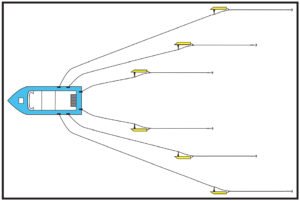
- Slowly begin to troll. The planer board will pull the line and lure away from the boat. Let out more line until the board is at your desired distance.
- Repeat this process for each line you want to run. A common setup is to have lines at varying distances from the boat to cover a wider area.
- Trolling Speed: Maintain a slow, consistent trolling speed. For most crappie crankbaits, a speed between 1.0 and 1.5 MPH is ideal. Use your boat’s GPS or trolling motor to keep your speed steady.
- Reeling in a Fish: When you get a strike, a couple of things can happen; the line may pop out of the release/clip on the planer board, or the board may just stop moving. In either case, grab the rod and begin to reel steadily. As you get the line back to the boat, you’ll reach the planer board. Unclip the board from the line and continue to fight the fish. Make sure there is constant tension on the line and don’t “bowstring” the line when you take the board off, as slack line can cause the fish to become unhooked.
TROUBLESHOOTING AND TIPS
- Tangle-Free Trolling: Run your lines at varying distances to prevent tangles. Your outside boards should have the shortest leads, with the deepest lines on the inside.
- Lure Action: Check your lures periodically to ensure they are running cleanly and not fouled with debris.
- Experimentation: The most successful anglers are those who experiment. Don’t be afraid to change your trolling speed, lure colors, or the depth of your baits until you find what the crappie want on any given day.
Trolling with Off Shore Tackle planer boards and crankbaits is a highly effective and exciting way to target crappie, especially on larger bodies of water. It’s a method that rewards patience and a bit of a learning curve but can lead to some of the most memorable crappie fishing experiences. So next time you’re on the water, consider trying this innovative and productive technique.