
A strong tradition for targeting brown trout exists in a host of Great Lakes waters. Typically, these fish provide some of the first open water angling opportunities of the year. Starting at ice out and lasting well into May, countless anglers target brown trout in Lakes Superior, Michigan, Huron, and Ontario.
Interest in catching brown trout seems to start waning about the same time water temperatures get right for targeting spring coho and chinook salmon. Brown trout may be the bridesmaids of salmonid fishing, but there are avid anglers who simply can’t get enough days on the water chasing Great Lakes browns.
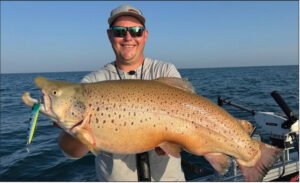
monster was caught on the Niagara Bar in Lake Ontario during the month of July. Summer time browns are an exciting alternative to trolling for salmon during the summer months.
LAKE ONTARIO
Of the four Great Lakes that are regularly stocked with brown trout, Lake Ontario stands out. Thanks to stocking contributions from the Ontario Ministry of Natural Resources and the New York State Department of Environmental Conservation, Lake Ontario is not just an excellent fishery, it’s a top sport fishing destination.
Stocking helps sustain this world class fishery, but Lake Ontario also benefits from nearly ideal habitat and a diverse forage base that consists of alewife, smelt, emerald shiners, gizzard shad and round goby, all of which brown trout slurp down without hesitation. Several rivers pour nutrient rich waters into Lake Ontario including the Niagara, Salmon, Genesee, Oswego, Trent and Black. The Welland Canal also contributes nutrient rich waters from Lake Erie.
Collectively these rivers help create what could only be described as picture perfect conditions for raising brown trout and other salmonids. Brown trout are regularly caught on Lake Ontario from the Welland Canal on the west end of the lake, all the way to the Salmon River in the east. The famed Niagara Escarpment forms a rocky shoreline of limestone and dolomite that in turn yields ideal habitat for brown trout.
Rocky shorelines stretch from the beach out to about 80 feet of water, setting up a west-to-east highway brown trout follow to find food and desirable water temperatures. Targeting brown trout in the summer time on Lake Ontario is about finding water temperatures in the 55 to 65 degree range that collide with rocky bottom structure.
A sub-surface temperature and speed probe is an absolute must for finding these fish. Without this invaluable piece of fishing electronics, it would be time consuming at best or impossible to pinpoint summer brown trout action.
TROLLING SETUPS
Summer brown trout on Lake Ontario are routinely taken using traditional trolling gear including downriggers, diving planers and lead core line fished in combination with in-line boards such as the Off Shore Tackle OR12. Spoons, shallow diving stickbaits and deeper diving crankbaits will all consistently take fish.
DOWNRIGGERS
A downrigger is a critically important piece of equipment for targeting summer browns. The downrigger is used to deploy the probe and to present baits close to bottom. Spoons and shallow diving stickbaits are the lures most used on the downrigger lines.
Off Shore Tackle makes several downrigger line releases suitable for brown trout fishing. My favorite is the OR8 Heavy Tension Downrigger Release. The extra tension of this line release makes it versatile enough to use with all common trolling gear. When setting the line from my trolling rods into the OR8, I grasp the line near the rod tip, fold the line over my index finger and twirl my finger to create a loop of line with a few twists. The twists of line are placed between the rubber pads on the OR8 letting the loop protrude an inch or two beyond the release jaws. This is commonly referred to as the “Loop Trick”.
This setup ensures the release has a firm grip on the line, eliminating any false releases, but when it’s time to trip the release to fight a fish or switch out baits, it’s a simple matter of giving the rod a quick upwards snap. The extra tension of the OR8 also helps to bury the hooks deep when a fish strikes.
DIVING PLANERS
Diving planers work to get gear to depth and to position the gear a little out away from the boat. Traditionally divers are rigged with a leader that’s approximately the length of the rod. This ensures that when the diver is reeled up to the rod tip, the fish will be close enough to easily net.
Rigging divers like a Snap Weight makes it possible to place the diver further up the line, eliminating any spooking factor of the diver. This rigging method starts by adding a 20 to 50 foot fluorocarbon leader to the main line. A double Uni knot is ideal for attaching a fluorocarbon leader to a braid main line. If wire is the main line, the Albright knot is a good choice for attaching fluorocarbon leaders to wire main lines.
On the trip arm of the diver, use a split ring to add an OR18 Snapper Release. Let the desired lure and leader out behind the boat, then attach the Snapper Release and attached diver to the line. Close the Snapper with the lever forward to ensure it remains firmly on the main line if using braid and on the leader if using wire as a main line.
The diver can now be deployed by backing off the reel drag until the diver slowly works its way out. When a fish strikes, a quick snap of the rod will trip the diver, leaving it dangling from the line like a Snap Weight. When the diver is reeled in close enough to reach, remove it from the line and continue fighting the fish to net. This simple setup is flawless and works on all the species commonly targeted using divers.
LEAD CORE AND BOARDS
Lead core is a sinking color marked line commonly used to target Great Lakes trout and salmon. A rigging method known as segmented lead core consists of a select length or color of lead core line that’s sandwiched between a backing line and leader. By staggering the amounts of lead core line used, anglers can target various depths and run multiple lead core rigs on each side of the boat.
Spoons work best when fishing segmented lead core because the spoon won’t dive down below the lead core, making it possible to hook fish on an outside line and reel in those fish without having to clear inside board lines.
Lead core is used by fishing the shorter and higher fishing lead core lines on outside boards, while longer and deeper lengths of lead core are fished on middle and inside board lines. The OR12 Side Planer is the perfect tool for fishing segmented lead core lines. The OR12 will handle all setups of lead core from one color out to 10 colors with ease.
Anglers who use monofilament line as a backing line can use the OR12 exactly the way it comes out of the package with an OR19 release on the bracket and an OR16 Pro Clip at the rear of the board. Those anglers who use braid as a backing line will want to rig the OR12 with either a OR18 Snapper Release or an OR39 Sam’s Pro Release on the bracket and an OR18 at the rear of the board.
SUMMING IT UP
Anglers who are looking to target brown trout should consider a trip to Lake Ontario in the summer months. In June, July, August and September, it’s a safe bet that brown trout will be found in 20 to 80 feet of water. Use a probe to pinpoint where 55 to 65 degree water hits the bottom and concentrate efforts trolling those depths. The rewards might just be the biggest brown trout of your life!